
Air Purifiers · Product analysis
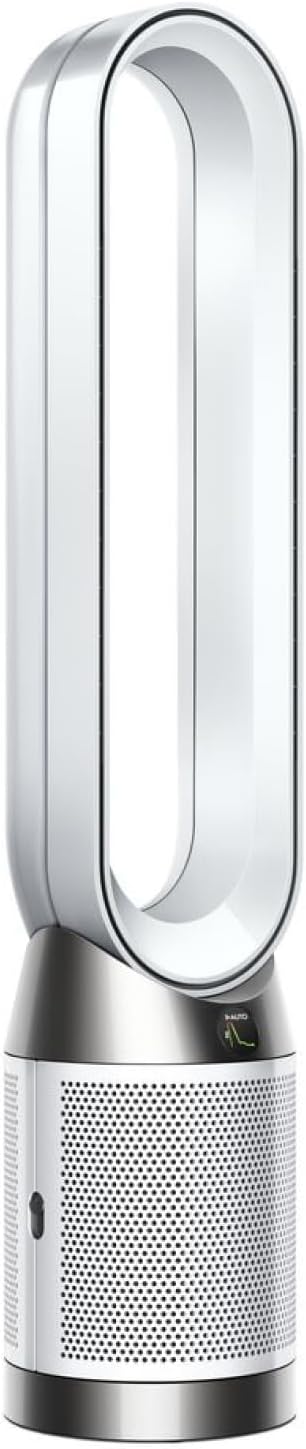
Dyson Purifier Cool TP07
The Dyson Purifier Cool TP07 is a $530 bladeless tower that combines sealed H13 HEPA filtration with an oscillating fan, and it scores 7.7 out of 10 - the same overall as the $220 Levoit Core 400S. It earns the only smart 10 in this catalog: app control, onboard sensors and auto mode. It gives that ground back on clean air, where it scores 5 out of 10.
Dyson publishes no CADR figure, and independent testing places raw throughput below same-price towers, so our engine flags the entry and rates it conservatively. The decision is simple. If you want a summer fan and a purifier in one appliance, the price makes sense. If you only want clean air, it does not.
Dyson
Purifier Cool TP07
Sealed HEPA purification inside a bladeless fan
Typical price
$530
Strengths
- excellent Smart (10/10) — app + sensors + oscillating fan
- high-end Quiet (8/10) — 24 dB
Worth considering
- Clean air could be better (5/10) — 100 CADR
Habilytics Score
Clean air 5/10: no published CADR, 300 sq ft coverage, throughput flagged as below-class.
Quiet 8/10: a 24 dB floor, matching the Core 400S but above Blueair's 18 dB.
Smart 10/10: app, onboard sensors, auto mode and oscillation - the catalog's only smart 10.
Key specs
| Smoke CADR | 100 CFM |
| AHAM room size | 300 sq ft |
| Noise floor | 24 dB |
| Power draw | 40 W |
| Features | app + sensors + oscillating fan |
| Street price | $530 |
| Typical price | $530 |
Prices are typical US street prices (approximate) and move often — check Amazon for the live price.
A 7.7 that ties a $220 purifier
Three units in this catalog score 7.7 overall: the Levoit Core 400S at $220, the Winix 9800 at $300, and this Dyson at $530. That is the cleanest way to frame the TP07. It is a good appliance, not a great purifier, and it costs more than twice what an equally scored alternative costs.
The 7.7 is built unevenly. Smart scores a perfect 10, the only unit here to manage it - app control, onboard sensors, auto mode, and an oscillating fan the others do not have. Quiet scores 8 on a 24 dB floor. Clean air scores 5, and that is the number most buyers should weigh first, because it is the thing a purifier is for.
Compare the shape of the Core 400S: clean air 6, quiet 8, smart 9, on 256 CADR and 433 sq ft of rated coverage. It beats the Dyson on the dimension that matters most and gives up only the fan and one point of smart. The TP07 does not out-purify anything at its price. It out-features them.
The clean air score is 5, and here is why
Dyson publishes no CADR figure for the TP07, and CADR is the one number that tells you how much clean air a purifier actually delivers per minute. Independent testing places its raw throughput below same-price towers, so our catalog carries a conservative 100 CADR placeholder, flags the entry as unverified, and the engine scores clean air at 5 out of 10 on that basis. Rated coverage is 300 sq ft.
Set that against the rest of the catalog at similar money. The Blueair Blue Pure 211i Max is $350, scores 9 on clean air, and is rated for 635 sq ft on a 400-class CADR. The Winix 9800 is $300, scores 7, and covers 500 sq ft. Even the $250 Honeywell HPA300 scores 7 on 300 CADR. Among everything here priced at $250 or more, only Dyson's own cheaper TP10 scores worse on clean air, and only the Medify MA-40 ties it.
If the reason you are shopping is wildfire smoke, spring pollen, or a pet allergy in a large open room, this is the wrong machine at this price. Buy throughput, and buy more of it than this.
What the $530 actually buys
Strip the purification argument away and the TP07 is still a real appliance. It is a bladeless oscillating fan wrapped around a sealed H13 filtration system, with onboard sensors, app control and auto mode, rated at 40 W. Only one other unit here also works as a fan - Dyson's own cheaper TP10 - and the rest are boxes that pull air in and push it upward.
That combination is why smart scores 10, the only smart 10 in this catalog. Auto mode responds to what the sensors read, the app handles control and reporting from elsewhere in the house, and the fan does a second job for as long as your summer lasts. If you were going to buy a room fan anyway, $530 reads differently than it does judged purely as a purifier.
The 24 dB floor supports that dual-use case: quiet enough to sleep beside, and an exact match for the Levoit Core 400S. It is not the quietest here - the $140 Blueair Blue Pure 411i Max runs at 18 dB and takes the only 10 for quiet - but 24 dB is a genuine bedroom-grade number, and 40 W is a lighter draw than the 77 W Coway AP-1512HH or the 130 W Honeywell HPA300.
When the cheaper Dyson is the right call
Dyson sells a cheaper version of this idea. The Purifier Cool Gen1 TP10 is $380, uses the same sealed HEPA and bladeless fan format, and swaps the app and Wi-Fi for a remote and a timer. It keeps auto mode. It is rated for 250 sq ft and 36 W, and it scores 5.7 overall against this unit's 7.7.
Almost the entire gap is smart: 10 versus 5. Clean air drops from 5 to 4, and quiet is identical at 8, with both units running a 24 dB floor. So the $150 you save buys a machine that purifies slightly less, covers a smaller room, and cannot be reached from your phone.
Take the TP10 only if you are sure you want the Dyson fan format, will never open an app, and are treating a smaller room. Anyone else tempted by the saving should look sideways rather than down: at $350 the Blueair Blue Pure 211i Max costs $30 less than the TP10 and scores 8.7 overall on a 400-class CADR and 635 sq ft. Buying a weaker Dyson to save money is the worst version of this trade.
Sizing it to your room
Our catalog rates the TP07 for 300 sq ft, which in practice means a bedroom, a home office, or a small living room - not an open-plan main floor. Push it into a big space and the weakest dimension gets weaker, because a unit that already scores 5 on clean air in the room it is rated for will do less in a room it is not.
That constraint sits awkwardly against the fan. The reason to want an oscillating purifier is usually the living room in July, which is exactly the room this one is least sized for. If your fan need and your purifier need are in the same large space, two separate machines serve you better: a purifier with real throughput, plus whatever fan you like.
The TP07 makes the most sense in a single room you occupy for long stretches - a bedroom where you want air moved over the bed, or an office where 24 dB, sensors and an app matter more to you than raw airflow. Bought for that room, the 7.7 holds up. Bought as the main purifier for a whole floor, it does not.
Who it's for / who it's not
Who it's for
- Buyers who want one appliance to be both a bedroom purifier and an oscillating summer fan
- Smart-home households that will actually use the app, onboard sensors and auto mode every day
- Light sleepers in rooms up to 300 sq ft, where the 24 dB floor is enough
- People who value sealed H13 filtration and design over raw airflow, and know they are paying for it
Who it's not for
- Anyone buying primarily for wildfire smoke, pollen or pet dander: clean air scores only 5 out of 10
- Open-plan main floors above 300 sq ft, where 400-class CADR units cost less and deliver more
- Value shoppers: the $220 Levoit Core 400S ties this 7.7 overall and beats it on clean air
Alternatives in our catalog
Blueair Blue Pure 211i Max — $350
Take the 211i Max if clean air is the whole point: 8.7 overall, 400-class CADR, 635 sq ft and 23 dB, for $180 less.
Head-to-head comparisonDyson Purifier Cool Gen1 TP10 — $380
Take the Gen1 TP10 only to save $150 on the same fan-plus-sealed-HEPA format without app control; it scores 5.7 overall and 4 on clean air.
Head-to-head comparisonSee how it ranks against the rest
We score every air purifier in our catalog on the specs that matter.
Best air purifiers of 2026Habilytics scores every air purifier with one deterministic engine reading specs we verify source by source: CADR and rated coverage for clean air, the quoted low-speed decibel figure for quiet, and app, sensor and auto-mode capability for smart. That research is exactly what catches the gaps: where a maker publishes no CADR, as here, the entry is flagged and scored conservatively.
Amazon links are affiliate links (tag: habilytics-20). As an Amazon Associate we earn from qualifying purchases at no extra cost to you. This never influences our scores or picks.