
Air Purifiers · Head-to-head
Dyson Purifier Cool TP07 vs Blueair Blue Pure 211i Max: Is the Dyson Worth $180 More?
These two land in the same shortlist for the same reason: both are smart purifiers with an app, a particle sensor and auto mode, and both are quiet enough to sleep next to. That is where the similarity stops. The Dyson costs $530 and doubles as a bladeless fan; the Blueair costs $350 and is built around one job - moving a lot of filtered air.
The engine scores the Blueair 8.7 and the Dyson 7.7, and the gap is not close on the dimension that decides whether a purifier does anything at all. The Dyson still wins one category outright. Here is what each number means for a real room.
The short answer
Pick the Dyson Purifier Cool TP07 if smart is what you are buying for — 10/10 against 9/10.
Pick the Blueair Blue Pure 211i Max if clean air is what you are buying for — 9/10 against 5/10, and it is the cheaper of the two by $180.
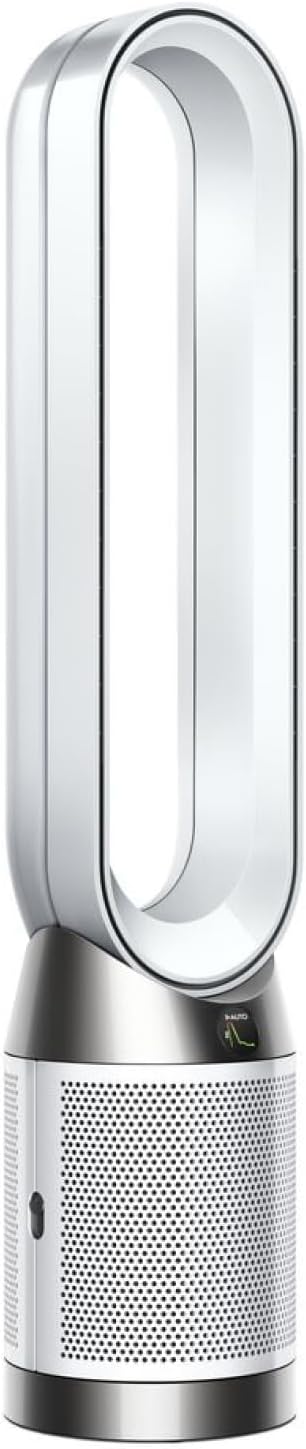
Dyson
Purifier Cool TP07
Sealed HEPA purification inside a bladeless fan
Typical price
$530
7.7
/10 overall

Blueair
Our pickBlue Pure 211i Max
HEPASilent throughput that embarrasses same-price towers
Typical price
$350
8.7
/10 overall
Scores side by side
| Dimension | Dyson Purifier Cool TP07 | Blueair Blue Pure 211i Max |
|---|---|---|
| Clean air | ||
| Quiet | ||
| Smart | ||
| Overall |
Key specs
| Spec | Dyson Purifier Cool TP07 | Blueair Blue Pure 211i Max |
|---|---|---|
| Smoke CADR | 100 CFM | 400 CFM |
| AHAM room size | 300 sq ft | 635 sq ft |
| Noise floor | 24 dB | 23 dB |
| Power draw | 40 W | 45 W |
| Features | app + sensors + oscillating fan | app + sensor + auto |
| Street price | $530 | $350 |
| Typical street price | $530 | $350 |
Clean air: 400 CADR against 100
This is the dimension that separates them, and it is not subtle: clean air 9/10 for the Blueair, 5/10 for the Dyson. The Blueair sits in the 400 CADR class with 635 sq ft of AHAM-rated coverage. The Dyson's catalog figure is 100 CADR over 300 sq ft. Four times the throughput, roughly twice the rated room.
The Dyson number carries an asterisk that cuts both ways. Dyson does not publish an AHAM CADR for the TP07, so the 100 is a conservative placement drawn from independent testing that puts its raw throughput below same-price towers, and the score is flagged for exactly that reason. It is not a measured Dyson figure, because Dyson has not published one. Scoring it generously would be the dishonest move.
Wattage widens the gap instead of narrowing it. The Blueair draws 45 W against the Dyson's 40 W - five watts more for four times the clean air, or roughly 8.9 CADR per watt versus 2.5. Read Blueair's own marketing with the same skepticism, though: its 3,235 sq ft claim assumes one air change per hour, which is not enough during pollen or wildfire season. The 635 sq ft AHAM figure is the one to plan around, and it is still more than double the Dyson's 300.
Quiet: a real tie, and why it still favors the Blueair
Both score 8/10, and both earn it: 23 dB for the Blueair, 24 dB for the Dyson. One decibel is not a difference anyone hears, so treat this as a genuine tie and stop comparing the numbers. Both are quiet enough to run in a bedroom overnight, which matters more than it sounds. A purifier only works while it is switched on, and the fastest route to zero clean air is a machine irritating enough to shut off at bedtime.
Where the tie stops being neutral is sizing. Noise floors are the lowest-speed figure, and how often a purifier stays on its lowest speed depends on how much room it has to spare. The Blueair is rated for 635 sq ft; the Dyson for 300. Put both in the same 300 sq ft bedroom and the Blueair has headroom the Dyson does not, so it spends more of its life at the quiet setting the 23 dB figure describes. The Dyson is working at the edge of its rating in that same room.
One caveat on the Dyson: 24 dB is its purifier floor, not the sound of a bladeless fan pushing air you can actually feel across a room. The fan is a large part of why anyone buys it, and using the fan is not a 24 dB activity.
Smart features: the one category the Dyson wins outright
This is the Dyson's category and it takes it cleanly: 10/10 against 9/10, the only perfect score between the two. Both machines carry the same core kit - an app, a particle sensor and a working auto mode - so on the automation that matters day to day they are close. The Dyson pulls ahead on the fullness of the package: the sensor array, the app, the sealed H13 system, and the oscillating fan built into the same body.
The fan is the honest argument for spending more. This is a purifier you can point at yourself in August, which no tower purifier does. If a room fan is on the shopping list anyway, two appliances collapse into one - one outlet, one corner, one thing to move between rooms. That reframes the $180 gap: the premium is not buying cleaner air, it is buying a fan and the best-equipped control setup of the pair.
What it does not buy is throughput. A 10/10 on smart features sits directly beside a 5/10 on clean air, and no amount of sensor resolution pushes more air through a filter. The Blueair's 9/10 means very little automation is surrendered in exchange for four times the clean-air delivery. That is the trade in one line.
Price: the ranges do not overlap
List prices are $530 for the Dyson and $350 for the Blueair, a $180 gap. The wider ranges are more revealing: the Dyson trades between $450 and $650, the Blueair between $300 and $400. Those bands never touch. Even at the bottom of its range the Dyson is $50 above the top of the Blueair's, so patience does not close the distance - it narrows the gap to $50 in the most favorable case and stretches it to $350 in the least.
Set that against what the money delivers. At $350 the Blueair is 400 CADR class over 635 sq ft. At $450, the Dyson's floor, the catalog figures are 100 CADR over 300 sq ft, plus the fan and the sensor package. Per dollar of clean air this is not a close call, and the overall scores reflect it: 8.7 to 7.7.
The case for spending up survives only if the fan and the packaging are worth paying for on their own terms. If the purchase is about air, the $180 travels in the wrong direction. Room size is the final sanity check: above 300 sq ft the Dyson is outside its rated coverage and the comparison ends there, regardless of budget or brand preference.
Choose the Dyson Purifier Cool TP07 if…
- Better smart: 10/10 against 9/10
Choose the Blueair Blue Pure 211i Max if…
- Higher overall score: 8.7/10 against 7.7/10
- Better clean air: 9/10 against 5/10
- Costs $180 less: $350 against $530
Verdict
Buy the Blueair Blue Pure 211i Max. It scores 8.7 to the Dyson's 7.7 because it delivers four times the clean air over twice the rated area for $180 less, and it is a decibel quieter doing it. Buy the Dyson Purifier Cool TP07 only if a summer fan and the fullest sensor-and-app setup in one bladeless unit are genuinely wanted, in a room of 300 sq ft or less, accepting that the 5/10 clean-air score is the price of that packaging. If throughput is the reason for shopping, the cheaper machine is the better machine.
Still not sure?
Answer a few questions about your space and how you will use it, and the engine narrows the whole catalog down to the air purifier that fits.
See also
Scores come from published manufacturer specs, normalized 1 to 10 across the whole catalog: clean air (cadrSmoke, CADR), quiet (noiseDbMin, dB), smart (features). The overall figure is the weighted mean of those dimensions, and the same weights apply to every model on the page.
Amazon links are affiliate links (tag: habilytics-20), at no extra cost to you. Scores and selection are computed from verified specs and never influenced by commissions.