
Espresso Machines · Head-to-head
Breville Barista Touch Impress vs Philips 5500 LatteGo: Which Espresso Machine Should You Buy?
One of these machines makes better coffee. The other makes coffee with less of you involved. That is the whole comparison, and the $530 between them is what it costs to move from one to the other. The Barista Touch Impress is a semi-automatic that automates the parts new owners get wrong - dose, tamp, milk texture - while leaving the espresso itself under your control.
The 5500 LatteGo is a super-automatic: bean to cup at a button, twenty hot and iced presets, no puck to handle. Our engine scores published specs rather than opinions, and it puts the Breville ahead, 8.7 to 8.3. That gap is real but narrow, and it is not the whole story.
The short answer
Pick the Breville Barista Touch Impress if espresso is what you are buying for — 9/10 against 7/10.
Pick the Philips 5500 LatteGo if ease is what you are buying for — 10/10 against 8/10, and it is the cheaper of the two by $530.

Breville
Our pickBarista Touch Impress
The full stack: assisted puck, auto milk, touchscreen
Typical price
$1350
8.7
/10 overall
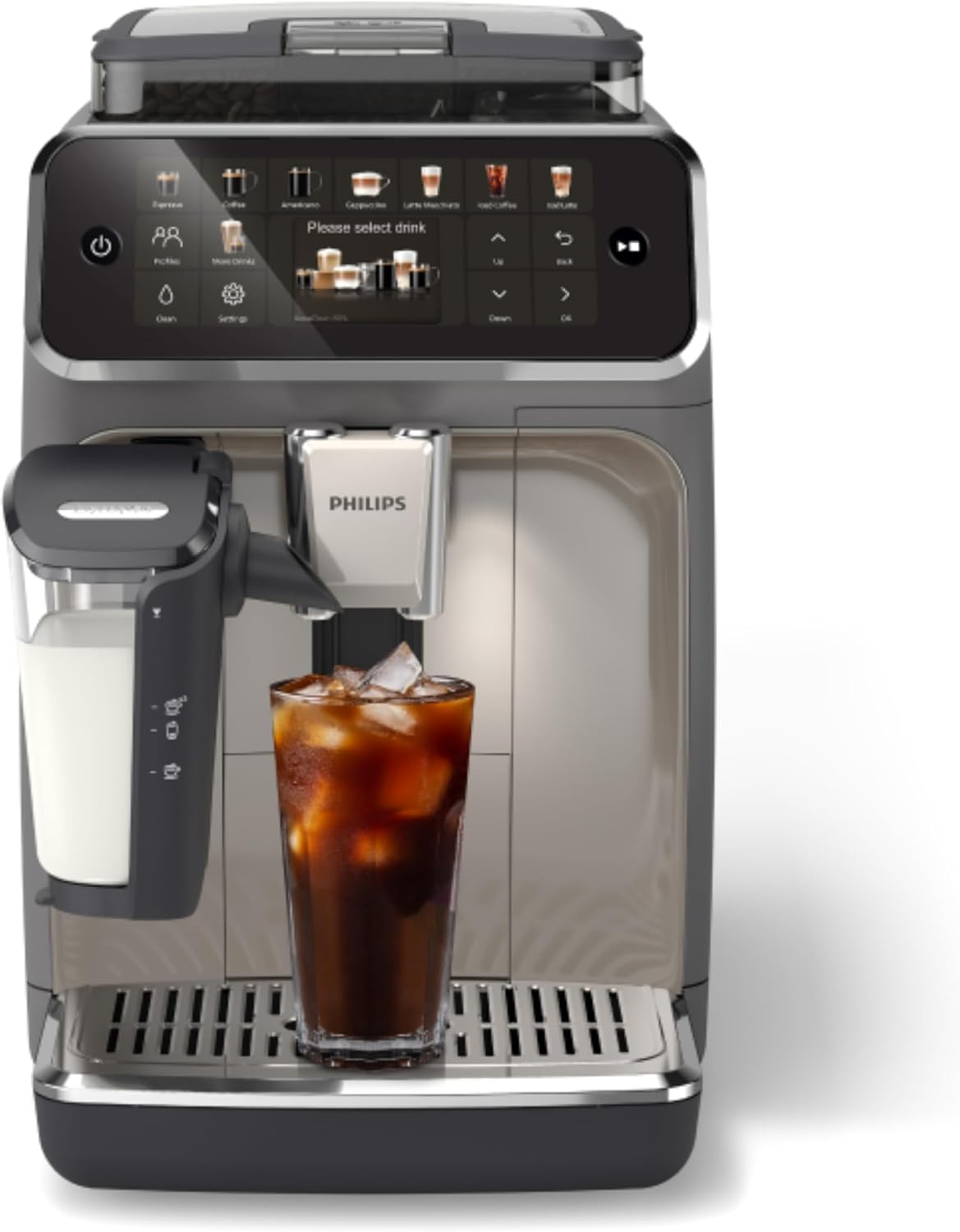
Philips
5500 LatteGo
20 hot & iced presets — the convenience ceiling
Typical price
$820
8.3
/10 overall
Scores side by side
| Dimension | Breville Barista Touch Impress | Philips 5500 LatteGo |
|---|---|---|
| Espresso | ||
| Milk | ||
| Ease | ||
| Overall |
Key specs
| Spec | Breville Barista Touch Impress | Philips 5500 LatteGo |
|---|---|---|
| Machine class | semi | super |
| Built-in grinder | Yes | Yes |
| Milk system | auto-wand | auto-milk |
| Street price | $1350 | $820 |
| Typical street price | $1350 | $820 |
Where the 0.4 points actually come from
Three dimensions feed the overall score: espresso quality, milk drinks, and ease of use. The Breville wins two of them and loses one badly. Espresso quality is the widest gap, 9 against 7, and it is structural rather than a matter of tuning. A semi-automatic puts the puck in your hands; the Impress workflow doses and tamps for you and shows the correction on the touchscreen, so the stage that ruins espresso for new owners is handled without removing the control that makes it good.
A super-automatic seals that stage inside a brew unit. It is consistent, and consistent is not the same as high. A 7 is a solid daily-driver number, not a bad one, but 7 is what a machine gets when the manufacturer sets the ceiling instead of you. Milk goes the same way by a smaller margin: 9 for the auto-texturing wand against 8 for the carafe system.
Ease of use flips hard, 10 for the Philips against 8 for the Breville. Weighted together, a two-point lead in the cup plus a point on milk outruns a two-point deficit in convenience, and 8.7 beats 8.3. Note what the engine is not saying: it is not saying the Breville is easier, and it is not saying 0.4 points is a lot.
The Philips wins ease outright, and that counts for more than it sounds
A 10 on ease of use is the highest number either machine posts on any dimension, and the Philips owns it. Twenty hot and iced presets means the drink your household argues about is already a button, and having iced drinks on that list matters through an American summer. QuickStart shortens the distance between wanting coffee and holding it. SilentBrew is on the listing too, which counts for more than people expect in an open-plan kitchen at 6am. Carafe milk systems are the least-effort and easiest-to-clean option in this category, and the carafe is what the Philips uses.
Set against that, the Breville's 8 is honest. It is a genuinely approachable semi-automatic, guided on screen and hands-free on milk, but it is still a machine with a portafilter. You lock it in, you knock the puck out, you wipe the basket. Two extra minutes and a habit. Some people find that pleasant and some find it a tax they pay every morning for years.
That is a temperament question, not a budget one, and it is worth answering honestly before spending anything. A higher-scoring machine nobody in the house wants to operate loses to a lower-scoring one that gets used, every time. The engine cannot see who lives in your kitchen. You can.
What the extra $530 buys
At reference prices the Breville is $1,350 and the Philips $820. That is 65 percent more money for 0.4 more points of overall score, and on score per dollar the Philips wins outright - there is no arithmetic that makes the flagship the value pick. Street pricing does not close it either. Our tracked range runs $1,200 to $1,550 for the Breville and $750 to $950 for the Philips, so the friendliest pairing of those ranges still leaves a $250 gap and the unfriendliest leaves $800.
So the premium is not a value argument. It is a ceiling argument. What $530 buys is the 9 in the cup and the 9 on milk: the ability to pull a better shot than the Philips can, and to keep getting better at it, instead of owning a machine that is as good on day one as it will ever be. Both include a burr grinder, so neither carries the hidden grinder budget a portafilter machine without one would add.
One thing worth weighing before paying it. If your household order is lattes and flat whites, milk carries most of what you taste, and the two-point espresso gap is the part of the premium you will notice least. The one-point milk gap is the part you might.
When to buy neither
Both machines assume milk. The auto-texturing wand on one and the carafe on the other are a large share of what you are paying for. If the order in your house is straight espresso and americanos, both are overspecified, and the money goes further on a simpler machine with a good grinder. Say that in the wizard and the engine will route you there.
Skip the Breville if you want to be hands-on rather than assisted. Its entire design is a machine making decisions you may want to make yourself, and a plain semi-automatic hands you the same control for much less while asking you to learn. Paying flagship money for guidance you intend to ignore is a bad trade.
Skip the Philips if in-cup quality is the reason you are buying at all. A 7 is respectable and it will make coffee you are happy with every morning for years, but if you already know the difference between a good shot and an acceptable one, that ceiling will find you.
Skip both if $820 is a stretch. Espresso is one of the few categories where cheaper machines with a real grinder produce genuinely good results, and the catalog runs well below either of these. A cheaper machine you use beats a flagship you bought tight.
Choose the Breville Barista Touch Impress if…
- Higher overall score: 8.7/10 against 8.3/10
- Better espresso: 9/10 against 7/10
- Better milk: 9/10 against 8/10
Choose the Philips 5500 LatteGo if…
- Better ease: 10/10 against 8/10
- Costs $530 less: $820 against $1350
Verdict
Buy the Barista Touch Impress if what lands in the cup is the point and the ritual sounds like a feature rather than a chore. It wins espresso quality and milk drinks, and 8.7 is the higher score for reasons you can taste. Buy the 5500 LatteGo if the machine has to serve a household rather than a hobbyist: a 10 on ease, twenty presets, $530 less. That is the right call more often than a 0.4-point gap suggests. The Breville only earns its premium from someone who will actually use the control it hands over.
Still not sure?
Answer a few questions about your space and how you will use it, and the engine narrows the whole catalog down to the espresso machine that fits.
See also
Scores come from published manufacturer specs, normalized 1 to 10 across the whole catalog: espresso (type), milk (milkSystem), ease. The overall figure is the weighted mean of those dimensions, and the same weights apply to every model on the page.
Amazon links are affiliate links (tag: habilytics-20), at no extra cost to you. Scores and selection are computed from verified specs and never influenced by commissions.