
Espresso Machines · Product analysis
De'Longhi Stilosa (EC260)
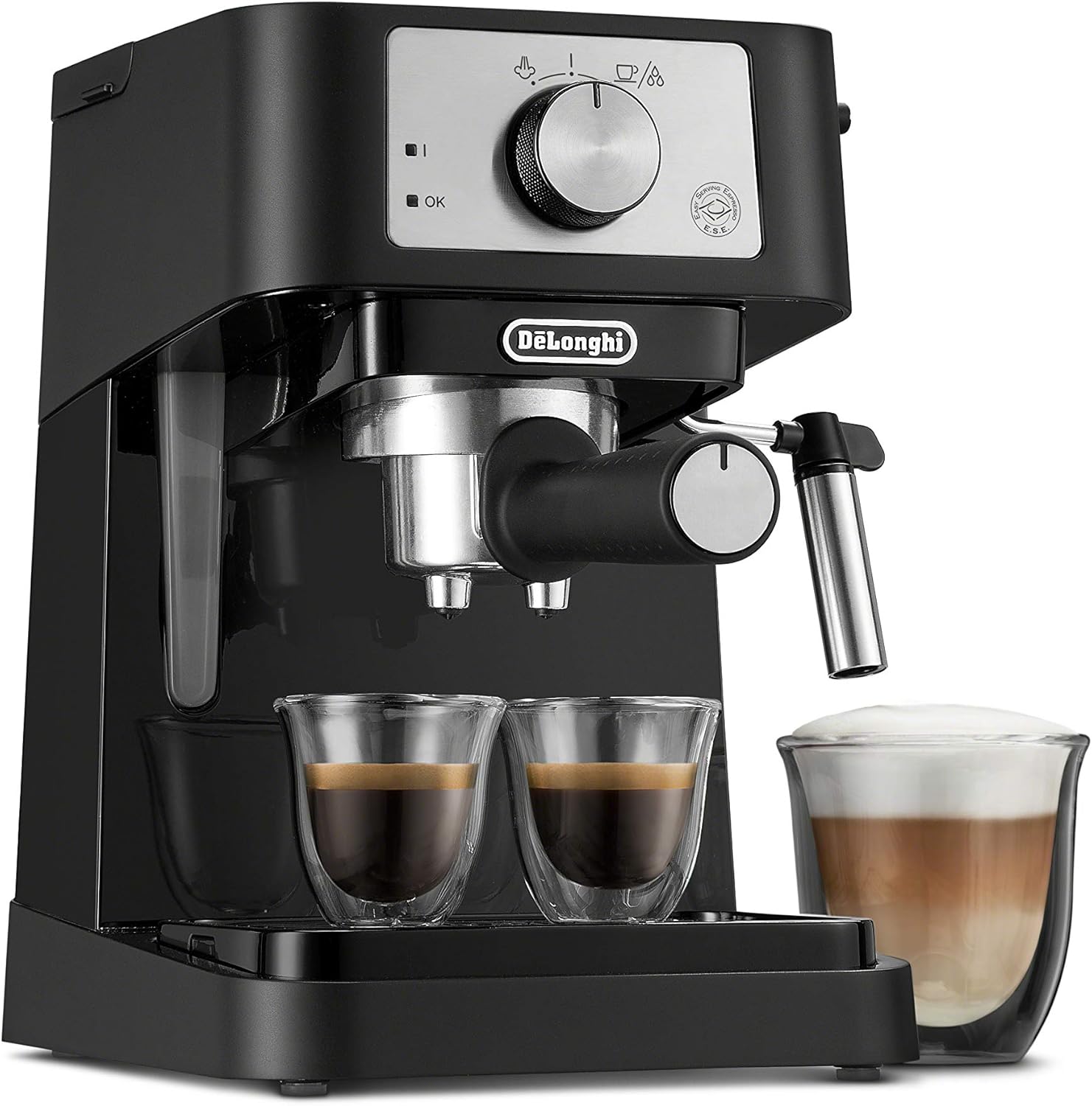
The Stilosa (EC260) is the cheapest way into real espresso in this catalog: about $110 for a 15-bar pump machine with a manual steam wand and no grinder. It also carries the lowest overall score here, a 4 out of 10, tied with the Casabrews 3700. That is not a contradiction.
The Stilosa does the one thing it promises - it pushes hot water through a portafilter at espresso pressure - and leaves everything else to you. The single fact that decides this purchase: you need a separate burr grinder. Buy the Stilosa alone with a bag of pre-ground coffee and you will conclude, wrongly, that espresso is not for you.
De'Longhi
Stilosa (EC260)
The $110 gateway drug to real espresso
Typical price
$110
Worth considering
- below-average Ease (3/10)
- below-average Milk (4/10) — wand
Habilytics Score
15-bar pump is real espresso hardware, but no grinder caps extraction at 5.
A manual steam wand and no auto frother: every cappuccino is your technique.
Manual machine, no grinder: you dose, tamp, time and steam every shot.
Key specs
| Machine class | manual |
| Built-in grinder | No |
| Milk system | wand |
| Street price | $110 |
| Typical price | $110 |
Prices are typical US street prices (approximate) and move often — check Amazon for the live price.
What $110 buys, and what it does not
The spec line is short because the machine is: manual, no grinder, steam wand. A 15-bar pump and that manual wand are what the listing states, and that is the whole feature set. Every step a more expensive machine takes over - grinding, dosing, tamping, timing the shot, texturing the milk - stays with you, and nothing on the machine coaches you through it.
The pump is what makes this a real espresso machine rather than a coffee gadget, and it is the same headline pressure figure quoted for the $250 Dedica (EC680). Worth knowing before anyone assumes the step up buys a fundamentally different extraction. What separates them on the score sheet is smaller than the price gap suggests: the Dedica takes espresso 6 to the Stilosa's 5, milk 5 to 4, ease 4 to 3, for an overall 5 against 4.
The ownership record is the other thing $110 buys. Roughly 13,000 reviews and a consistent roundup consensus as the safest affordable entry mean the unit is not a lottery ticket. That is a specific and limited compliment. Nothing in that record says the coffee is good. It says the machine will not be the reason the coffee is bad. Street price has moved between $90 and $140, so patience is worth something here.
The grinder is not optional
The note on this machine is blunt: it needs a separate grinder for real results. That is the most important sentence on this page. Espresso is ground far finer than drip coffee, and fine grounds go stale fast. Pre-ground supermarket coffee is usually too coarse and too old to build the resistance a 15-bar pump needs, and the shot comes out fast, thin and sour.
The machine gets blamed. The machine is not at fault. So the honest price is $110 plus a burr grinder, and the grinder is the purchase that decides whether the coffee is drinkable. That reframes every comparison on this page. Against the $630 Barista Express, which includes a conical burr grinder and scores espresso 8, the Stilosa is not really a $520 saving - it is whatever is left after the second box goes in the cart.
The upside is that the grinder is the part you keep. Machines get replaced when the hobby sticks; a good grinder follows you to the next one. Buying a cheap machine and a better grinder is a defensible order of operations, and it is the only version of this purchase that reliably produces espresso anyone would order twice.
Milk 4 and ease 3 are the honest problem
Both are the joint-lowest marks in this catalog: the milk score is shared only with the $140 Casabrews 3700, the ease score with the Casabrews and the $450 Gaggia Classic Evo Pro. The milk score reads straight off the hardware: a manual steam wand, and nothing to help you use it. No automatic frothing, no hands-free microfoam. Every latte is your pitcher angle and your patience.
The $500 Bambino Plus scores milk 8 on the strength of an automatic microfoam wand; the super-autos - the $500 Magnifica Start, the $500 Philips 3200 LatteGo - pour milk drinks at a button press. If cappuccinos are why you are shopping, this is the wrong end of the catalog, and no amount of practice changes the hardware. The ease score of 3 deserves more attention, because cheap reads as simple and it is not.
The Stilosa ties the $450 Gaggia Classic Evo Pro as the most demanding machine here, and the Gaggia at least repays that effort with an espresso score of 8. The Stilosa asks for the same manual discipline - grind, dose, tamp, time, steam - and returns a 5. High demand, modest ceiling. That combination is precisely why the overall sits at 4 out of 10, and it is the fair reading of this machine.
When to spend more instead
Three cases where the extra money is the better call. If you already know espresso will still be part of your mornings in five years, the $300 Bambino is the more sensible entry: semi-auto rather than manual, ThermoJet heat-up in three seconds, a 54 mm portafilter, and scores of 7 espresso, 6 milk, 5 ease for an overall 6.
It has no grinder either, so that purchase does not disappear - but the machine behind it is better. If milk drinks are the point, leave manual machines alone. The $500 Philips 3200 LatteGo scores milk 7 and ease 9; the $650 Magnifica Evo scores 7 espresso, 7 milk, 9 ease with an automatic milk carafe.
Neither reaches what a skilled hand gets from a good manual machine, but both make a decent cappuccino at 7 a.m. on a weekday, which is the real requirement in most kitchens. If you want one box that does everything, the $630 Barista Express is the default all-in-one: integrated conical burr grinder, espresso 8, overall 6.3. It costs $520 more than the Stilosa and removes the second purchase. None of those is $110, which is the whole reason the Stilosa keeps selling.
The case for buying it anyway
A 4 out of 10 is not an instruction to stay away. It is a description of a machine with one narrow job, which it does. The job is finding out whether you actually want this hobby. Espresso asks for real attention - weighing doses, adjusting grind, learning to steam - and plenty of people discover after a month that they would rather press a button and get on with the morning.
Learning that for around $110 instead of $630 is a good outcome, not a wasted purchase. The 13,000-plus review count and the roundup consensus as the safest affordable entry are exactly the profile you want in a trial: widely owned, unremarkable, unlikely to fail in a surprising way. There is a second case.
If a decent burr grinder is already on your counter, the Stilosa is the cheapest pump body in this catalog to put behind it, and the grinder is doing most of the work that decides shot quality. The scores do not move - espresso 5, milk 4, ease 3 - but the coffee gets noticeably better. Be clear about which purchase you are making. This is a trial, not a destination.
Who it's for / who it's not
Who it's for
- First-time buyers testing whether espresso sticks before committing to a $630 all-in-one with a grinder.
- Anyone who already owns a burr grinder and wants the cheapest credible pump body to pair with it.
- Offices, dorms and second kitchens where nobody is optimizing shots and the budget is genuinely $110.
- Espresso drinkers who take it straight, where the 4/10 milk score barely matters in practice.
Who it's not for
- Anyone planning to use pre-ground supermarket coffee - without a burr grinder the results will disappoint.
- Households built on cappuccinos and lattes: milk scores 4/10 and the wand is entirely manual.
- Anyone who wants coffee at a button press on a weekday - ease scores 3/10 here.
Alternatives in our catalog
De'Longhi Dedica (EC680) — $250
Worth the extra $140 if you already know espresso will stick: same manual format and no grinder, but it scores 5 overall against the Stilosa's 4.
Casabrews 3700 Essential — $140
At $140 it posts identical 5/4/3 scores with a 20-bar pump and a 43.9 oz tank - take it only if the bigger tank matters to you.
See how it ranks against the rest
We score every espresso machine in our catalog on the specs that matter.
Best espresso machines of 2026This score comes from a deterministic engine reading researched, verified specs - pump pressure, grinder, milk system, machine type - weighted the same way for every espresso machine in the catalog. Each figure is checked against its source, and affiliate commissions never move a score or a ranking.
Amazon links are affiliate links (tag: habilytics-20). As an Amazon Associate we earn from qualifying purchases at no extra cost to you. This never influences our scores or picks.