
Espresso Machines · Product analysis
Gaggia Classic Evo Pro
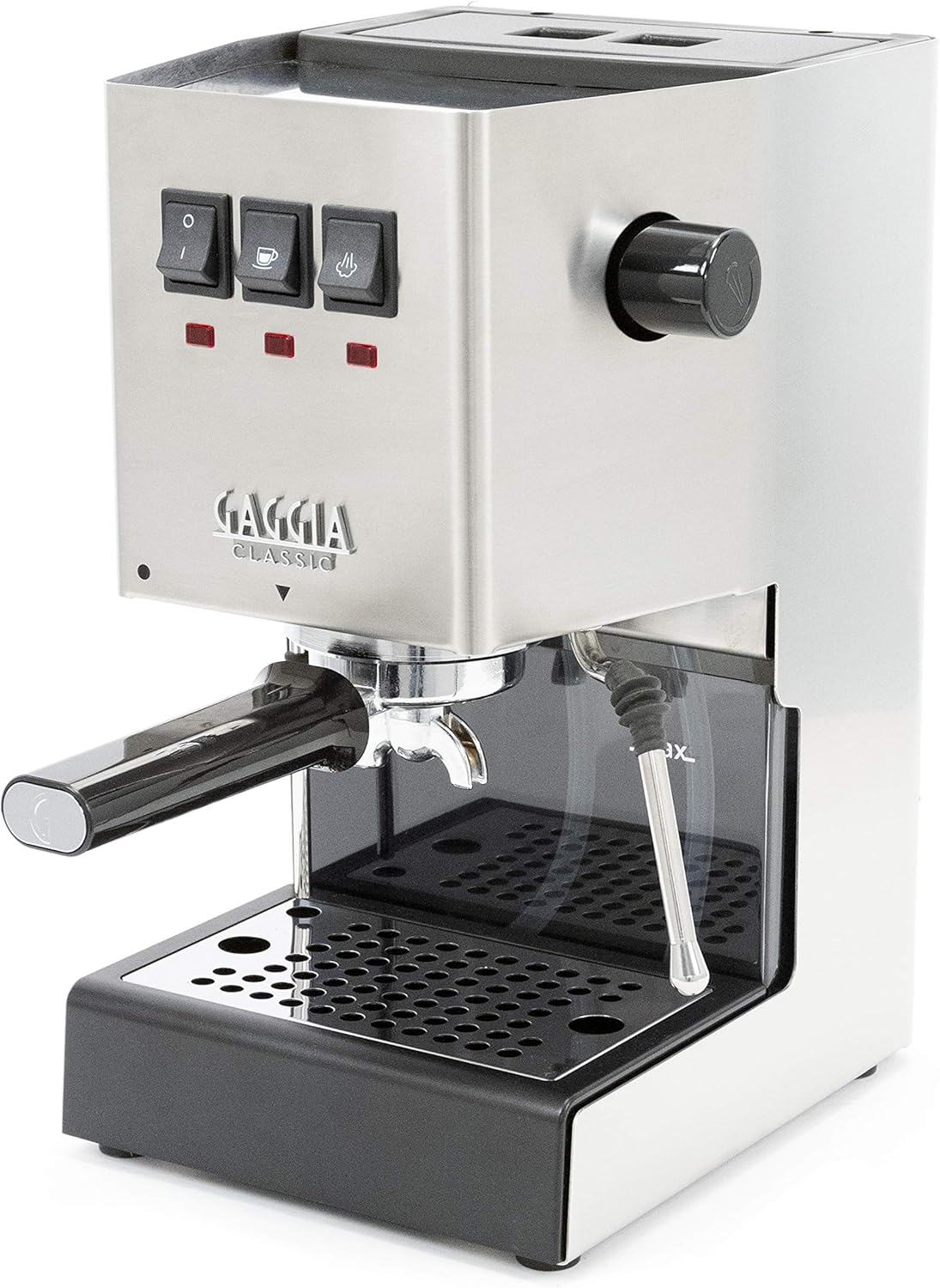
The Classic Evo Pro is Gaggia's entry into prosumer territory: a manual machine with a 58 mm commercial portafilter and a commercial steam wand, at a typical $450. That portafilter is the same size cafe equipment uses, which is why this machine has a modding community and a cult following. It is also the steepest learning curve in our catalog.
The engine gives it 8/10 for espresso and 3/10 for ease - tied with the two cheapest machines here for the lowest ease score we have. Overall it lands at 5.7/10, below most of the catalog. It ships without a grinder, so $450 is not the real entry price. What decides this purchase is whether you want espresso as a hobby or as a drink.
Gaggia
Classic Evo Pro
Commercial 58mm portafilter, cult following, zero shortcuts
Typical price
$450
Strengths
- high-end Espresso (8/10) — manual
Worth considering
- below-average Ease (3/10)
- Milk could be better (6/10) — wand
Habilytics Score
The 58 mm commercial portafilter is cafe-standard hardware; only grinder-equipped semi-autos score higher.
Commercial steam wand, but fully manual; auto-microfoam machines like the Bambino Plus score 8.
Manual type with no grinder and a manual wand - the steepest learning curve here.
Key specs
| Machine class | manual |
| Built-in grinder | No |
| Milk system | wand |
| Street price | $450 |
| Typical price | $450 |
Prices are typical US street prices (approximate) and move often — check Amazon for the live price.
What the 58 mm portafilter actually buys
The headline spec is a 58 mm commercial portafilter - cafe-standard diameter - paired with a commercial steam wand in the Evo Pro refresh. That matters for two practical reasons. First, 58 mm is the size the entire aftermarket is built around: bottomless portafilters, precision baskets, tampers, distribution tools and puck screens are all cheap and abundant at that diameter.
The Breville Bambino, by comparison, uses a 54 mm basket, which narrows what you can bolt on later. Second, this is the modding-community favorite in the catalog, so the upgrade path and the parts for it are unusually well documented. That hardware is why the engine gives it 8/10 for espresso, among the higher espresso scores here. It is not the highest.
Four machines score 9 - the Barista Touch Impress, La Specialista Maestro, Barista Express Impress and La Specialista Opera - and each of those has a built-in grinder doing part of the work. The Gaggia reaches 8 on brew hardware alone and then hands the rest of the job to you. Whether that becomes great espresso or bad espresso is a function of your grinder, your beans and your practice, not the machine.
Why ease scores 3 out of 10
Three out of ten is the lowest ease score in this catalog, shared only with the $110 Stilosa and the $140 Casabrews 3700 - two machines that are hard to live with because they are cheap, where the Gaggia is hard to live with because it is deliberate. The spec line is exactly three things: manual, no grinder, steam wand.
That means you dose, distribute and tamp by hand, judge the shot yourself, and adjust a separate grinder between attempts. Nothing on the machine diagnoses a bad shot for you. Our catalog notes call this the steepest learning curve of anything we score in espresso machines, and the score reflects that literally.
Ease is one of three equally weighted dimensions in the overall, so a 3 here is the single biggest reason this machine lands at 5.7 while the Breville Barista Express Impress - 9 for espresso, 7 for ease - reaches 7.3. If you are the kind of buyer who finds dialing in a grinder satisfying rather than annoying, the 3 is describing a feature you actually want. If you want coffee before work without thinking about it, the 3 is a warning, and it is accurate.
Milk is a manual skill here
Milk scores 6/10, and that number is about who does the work rather than what the hardware can do. The Evo Pro refresh brings a commercial steam wand, which is real steaming hardware and, in practiced hands, capable of proper microfoam. It is also entirely manual. You set the pitcher angle, find the stretch, judge the temperature by feel, and get no help at all when it goes wrong.
The Breville Barista Express, Barista Express Impress and La Specialista Arte Evo all score 6 for milk for exactly the same reason. What beats a 6 in this catalog is automation, not better steam: the Breville Bambino Plus reaches 8 with an automatic microfoam wand at around $500, and most of the super-autos with milk carafes land at 7 or 8 by taking the human out of the loop entirely.
So if your household drinks cappuccinos and lattes on a weekday schedule, this is the wrong tool and the score says so plainly. If you want to learn to steam milk properly, and are willing to waste some milk learning, a commercial wand is the right thing to learn on.
The $450 is not the whole price
The Classic Evo Pro has no grinder, and at a typical $450 that is the number to interrogate. A 58 mm commercial basket is only as good as what you put in it, and pre-ground coffee will not get you near the 8/10 espresso this machine is scored for. A capable burr grinder is a second purchase, and a serious one, so the real cost of getting good espresso out of this machine sits meaningfully above its sticker.
That reframes the whole comparison. At $500 the Philips 3200 LatteGo includes a ceramic grinder and a milk system and scores 7.3 overall. At $630 the Breville Barista Express includes a conical burr grinder and scores 6.3. At $780 the Barista Express Impress adds assisted dosing and tamping and scores 7.3. Each of those is one box, one counter footprint, one thing to learn.
The case for the Gaggia is real but narrow: keeping the grinder separate lets you put money exactly where it matters, upgrade either half on its own schedule, and stay inside a 58 mm parts ecosystem that is not going anywhere. That pays off only if you stay interested.
What a 5.7 means, and when to skip it
A 5.7 overall is a below-average result in this catalog and we are not going to dress it up. Only three machines score lower - the Dedica at 5.0, the Stilosa at 4.0 and the Casabrews 3700 at 4.0 - and all three are cheaper. Read the number for what it is: an average of a strong espresso score, an ordinary milk score and a very poor ease score.
That arithmetic is the machine. The thing to understand is that our overall answers how good this is for a general buyer, and the Gaggia is not built for a general buyer. It is built for someone who has already decided espresso is a hobby, who owns or is about to buy a real grinder, and who wants 58 mm gear and a machine that rewards practice and modification.
For that person the 5.7 understates it and the 8 for espresso is the number that matters. For everyone else - and that is most people reading this - the 3 for ease is the number that matters, and it means the machine sits unused or makes disappointing coffee. Be honest about which one you are before you buy.
Who it's for / who it's not
Who it's for
- You already own a burr grinder good enough to dial in a 58 mm basket.
- Espresso is a hobby you want to get better at, not a morning chore.
- You want cafe-standard 58 mm gear and the well-documented mod path that comes with it.
- You drink mostly straight espresso and do not mind steaming milk by hand occasionally.
Who it's not for
- Anyone who wants coffee in one button press on a weekday morning - ease scores 3/10.
- Households making several milk drinks daily: the manual wand scores 6 and never gets faster.
- Buyers whose $450 is the entire budget - there is no grinder in the box.
Alternatives in our catalog
Breville Bambino — $300
For confident beginners who want to use their own grinder without the Gaggia's learning curve: 5/10 ease instead of 3, a higher 6.0 overall, and $150 less.
Head-to-head comparisonDe'Longhi Dedica (EC680) — $250
Take the Dedica only if counter width or a $250 ceiling decides it: it scores lower on every dimension (6/5/4, 5.0 overall) and is a compromise, not an upgrade.
See how it ranks against the rest
We score every espresso machine in our catalog on the specs that matter.
Best espresso machines of 2026Scores come from our deterministic engine. It reads researched, verified specs - machine class, portafilter and steam-wand hardware, grinder presence - and scores espresso, milk and ease on the same rules for every machine in the catalog. The overall is those three, equally weighted. Prices are typical US street prices and move often.
Amazon links are affiliate links (tag: habilytics-20). As an Amazon Associate we earn from qualifying purchases at no extra cost to you. This never influences our scores or picks.