
Robot Vacuums · Head-to-head
Shark PowerDetect vs. iRobot Roomba 105 Vac: What $250 More Actually Buys
Both robots land in the same lane: LiDAR navigation, a self-emptying dock, no mop, and a cleaning score that's dead even. The split is price. Shark's PowerDetect asks $550; iRobot's Roomba 105 asks $300 for a near-identical spec sheet. If you're cross-shopping them, you're really asking one question — does the Shark's navigation edge justify nearly double the money?
The short answer
Pick the Shark PowerDetect (AV2820S) if navigation is what you are buying for — 8/10 against 7/10.
Pick the iRobot Roomba 105 Vac + AutoEmpty if the budget is the constraint — it does the same job for $250 less.

Shark
Our pickPowerDetect (AV2820S)
Detects floor type and dirt, never gets stuck
Typical price
$550
6.7
/10 overall
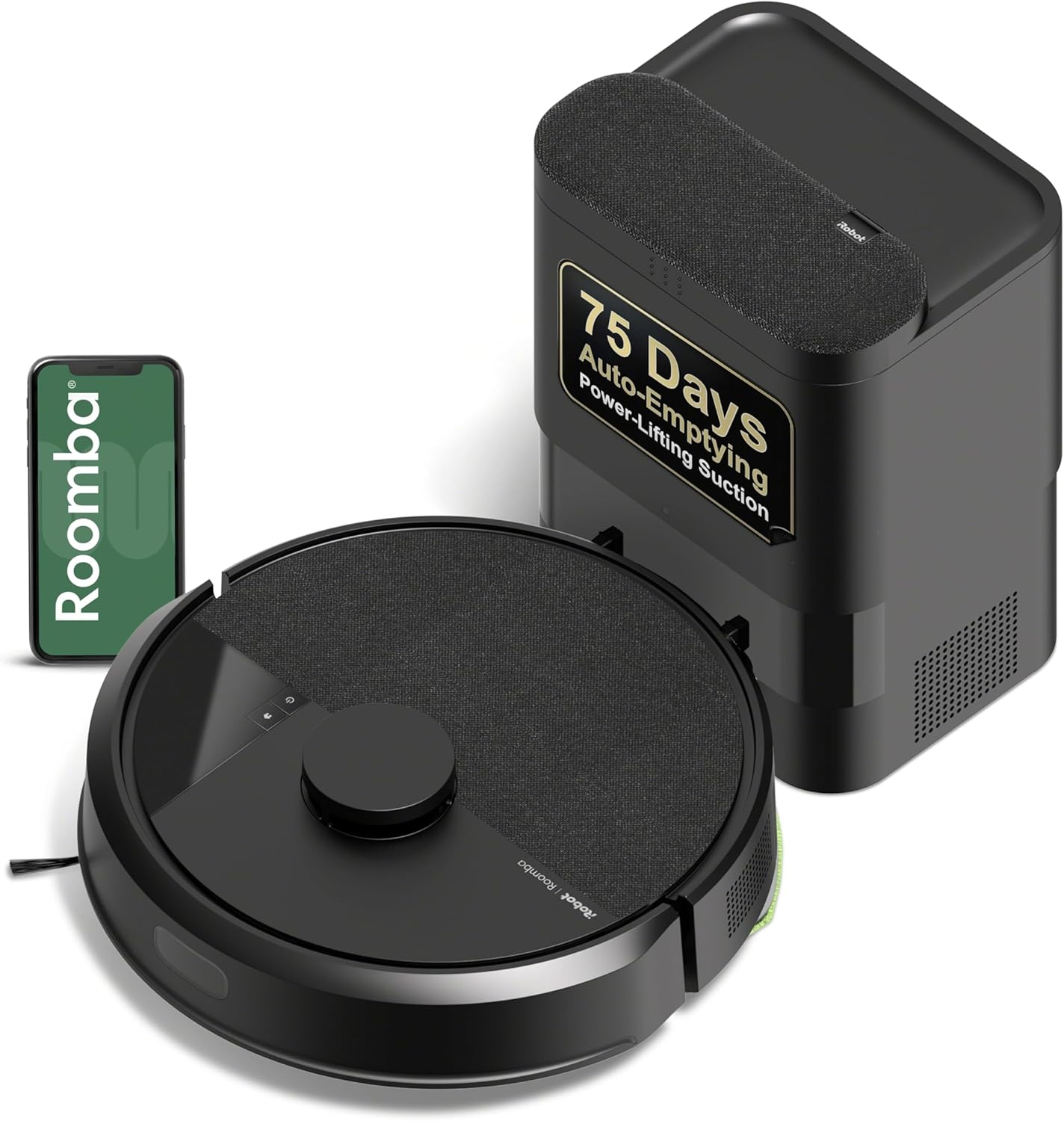
iRobot
Roomba 105 Vac + AutoEmpty
The new-generation Roomba with LiDAR and a 75-day dock
Typical price
$300
6.3
/10 overall
Scores side by side
| Dimension | Shark PowerDetect (AV2820S) | iRobot Roomba 105 Vac + AutoEmpty |
|---|---|---|
| Cleaning | ||
| Navigation | ||
| Autonomy | ||
| Overall |
Key specs
| Spec | Shark PowerDetect (AV2820S) | iRobot Roomba 105 Vac + AutoEmpty |
|---|---|---|
| Suction (advertised) | 8,000 Pa | 7,000 Pa |
| Dock | Self-empty dock (weeks between empties) | Self-empty dock (weeks between empties) |
| Mop system | None (vacuum only) | None (vacuum only) |
| Navigation | LiDAR + NeverStuck sensors | LiDAR |
| Typical street price | $550 | $300 |
The Suction Gap Is Mostly on the Box
Shark rates higher on paper, and the PowerDetect name implies dirt-sensing auto-boost. In practice, suction figures at this level follow steep diminishing returns — the difference between these two barely registers on an actual floor, and the engine scores both cleaning an identical 6/10. Read that as competent, not commanding: fine on hard floors and low-pile rugs, ordinary on thick carpet. Neither is a deep-clean specialist, and the Shark's bigger number buys no measurable pickup advantage over the Roomba.
Navigation Is Where Shark Earns Its Lead
Both navigate with LiDAR, so both build accurate maps and clean in orderly rows rather than bouncing around. The separation is Shark's NeverStuck hardware, and the engine backs it: 8/10 versus 7/10. That single point is about escape, not mapping — avoiding the wedged-under-the-couch, tangled-on-a-cord, stuck-on-a-threshold moments that force a mid-clean rescue. In a cluttered home with cords, dark rugs, or floor transitions, that margin is the most tangible thing your extra money buys. The Roomba still maps well; it just needs rescuing more often.
The $250 Question
Strip the two down and the overlap is striking: identical cleaning and autonomy scores, both self-empty, neither mops. Shark's overall edge (6.7 to 6.3) rests almost entirely on that one navigation point. So the math is honest — pay $300 for a robot that cleans the same and maps well, or $550 for meaningfully better unstuck behavior. One caveat covers both: no mopping, so vacuum-and-mop shoppers should skip this pair entirely. In a tidy, open home, the Roomba delivers most of the experience for far less money.
Choose the Shark PowerDetect (AV2820S) if…
- Higher overall score: 6.7/10 against 6.3/10
- Better navigation: 8/10 against 7/10
Choose the iRobot Roomba 105 Vac + AutoEmpty if…
- Costs $250 less: $300 against $550
Verdict
The Shark PowerDetect is the better robot and the engine's pick (6.7 to 6.3), and it earns that on navigation — buy it if your floors are cluttered with cords, thresholds, and furniture a lesser robot would get stuck on. But the Roomba 105 Vac cleans just as well for $250 less, and in an open, tidy home you'd struggle to feel the difference. Pay up for the Shark if you want fewer mid-clean rescues; take the Roomba if your floor plan is simple and your budget isn't limitless.
Still not sure?
Answer a few questions about your space and how you will use it, and the engine narrows the whole catalog down to the robot vacuum that fits.
See also
Scores come from published manufacturer specs, normalized 1 to 10 across the whole catalog: cleaning (suctionPa, Pa), navigation (nav), autonomy (dock). The overall figure is the weighted mean of those dimensions, and the same weights apply to every model on the page.
Amazon links are affiliate links (tag: habilytics-20), at no extra cost to you. Scores and selection are computed from verified specs and never influenced by commissions.