
Espresso Machines · Head-to-head
De'Longhi Magnifica Evo vs. Philips 4300 LatteGo: Same Score, So Which One Should You Actually Buy?
These two land on the same shortlist for a reason. Both are super-automatics with a built-in grinder and an automatic milk system, both sit in the mid tier, and both come out of the scoring at exactly 7.7 overall. Coffee 7, milk 7, ease of use 9 - the same three numbers, twice. That is not a hedge, it is the finding.
On published specs there is no quality gap between the De'Longhi Magnifica Evo at about $650 and the Philips 4300 LatteGo at about $720. The decision has to be made on things a score does not measure: how many different drinks your household orders, how you want milk handled, and whether the extra $70 buys anything you will use.
The short answer
Pick the De'Longhi Magnifica Evo if the budget is the constraint — it does the same job for $70 less.
Pick the Philips 4300 LatteGo if you find it cheaper on the day: the engine scores them level on every dimension.
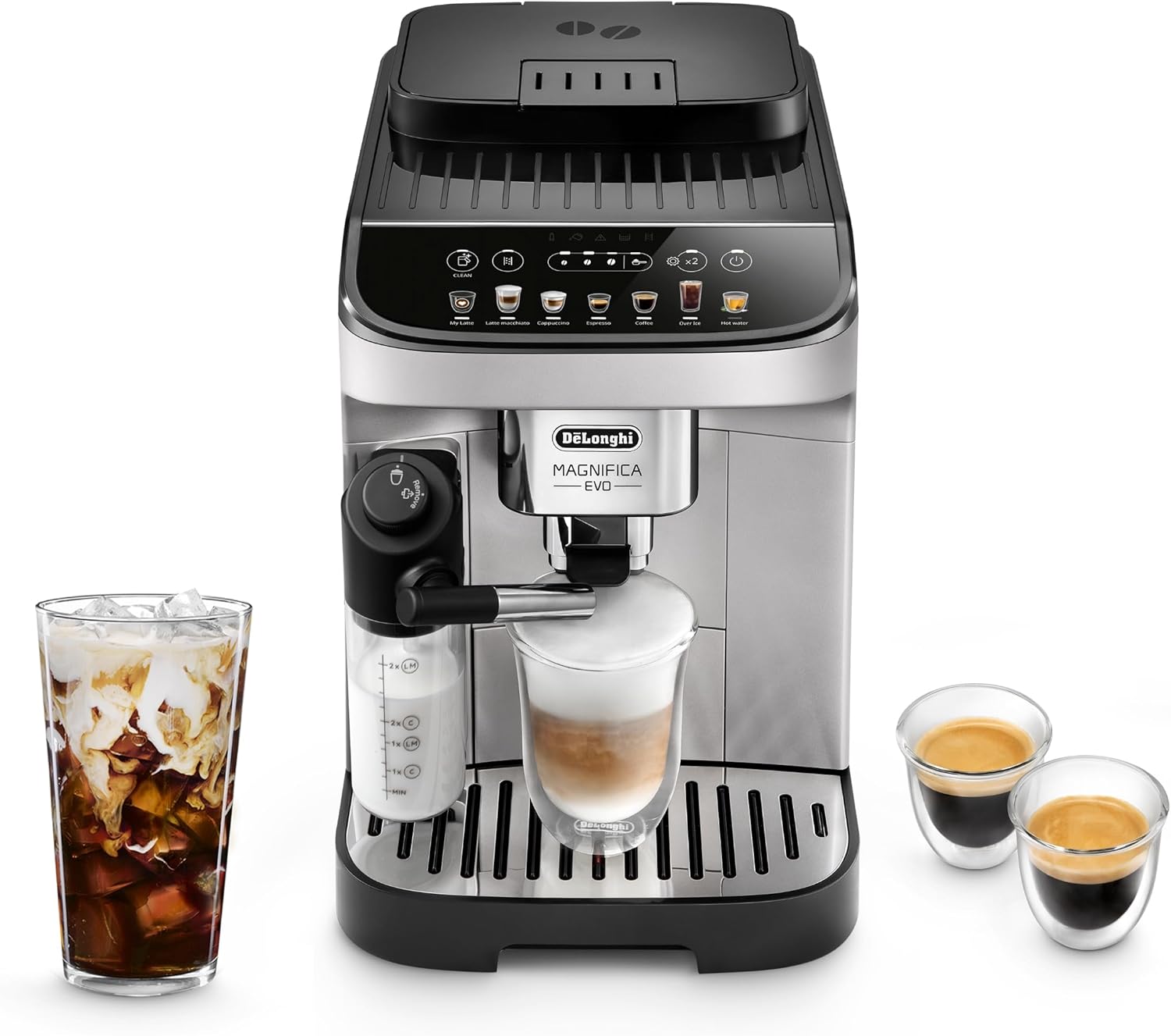
De'Longhi
Magnifica Evo
The best-selling super-auto with LatteCrema milk
Typical price
$650
7.7
/10 overall

Philips
4300 LatteGo
Eight drinks and per-user profiles in the mid tier
Typical price
$720
7.7
/10 overall
Scores side by side
| Dimension | De'Longhi Magnifica Evo | Philips 4300 LatteGo |
|---|---|---|
| Espresso | ||
| Milk | ||
| Ease | ||
| Overall |
Key specs
| Spec | De'Longhi Magnifica Evo | Philips 4300 LatteGo |
|---|---|---|
| Machine class | super | super |
| Built-in grinder | Yes | Yes |
| Milk system | auto-milk | auto-milk |
| Street price | $650 | $720 |
| Typical street price | $650 | $720 |
What a 7.7 tie actually tells you
Three axes, three identical numbers, so the overall matches. There is no tiebreaker hiding inside the weighted average, and no reason to keep hunting for one. Read the axes individually and they say something more useful than the total. Coffee sits at 7 for both. That is good, not great, and it is close to the ceiling for this machine class: a super-automatic decides dose, pressure, and temperature for you, which is exactly the control an espresso obsessive wants back.
Milk also sits at 7 for both. Both machines automate it, both do it competently for cappuccinos and lattes, and neither is the best milk performer in this catalog - a 7 means reliable foam, not latte-art microfoam. Ease of use is where both jump to 9, the highest score either one earns, and the honest reason to buy either.
Beans in, cup out, no grinder to load, no wand to purge, no milk to pitcher by hand. That is the product. So the real comparison is not which machine is better, because the specs say neither is. It is which one fits the way your kitchen actually runs in the morning.
Where the De'Longhi is genuinely better: price and the carafe
The Magnifica Evo lists at about $650 against the Philips at about $720. On reference price that is $70, which is real money for a machine the engine rates as its exact equal. The price ranges say more than the single figure: the De'Longhi tracks between $600 and $750, the Philips between $650 and $850.
The De'Longhi's ceiling is roughly the Philips' floor, so on a bad pricing day for the Philips the gap widens well past $70, and the De'Longhi is almost never the more expensive of the two. The specific model here is the ECAM29084SB, and the listing states a LatteCrema automatic milk carafe, an auto-clean cycle, and a built-in grinder. The carafe is the part worth understanding.
Milk lives in a detachable jug that goes back in the refrigerator with the milk still in it, and the machine runs its own clean cycle after a milk drink. For a household that makes the same cappuccino every morning and does not want to think about the milk path, that is the entire workflow handled. This is the machine for a busy house that drinks one thing well rather than six things occasionally.
Where the Philips is genuinely better: eight drinks and profiles
This is the tie's other half, and it is a real advantage rather than a consolation. The specific model is the EP4347/94, and the listing states eight drinks, a touch display, and the LatteGo milk system. The drink count is the whole argument. Eight one-touch options instead of a short menu, a touch display that makes those options findable instead of buried behind button combinations, and per-user profiles so each person's preferred strength and volume is saved rather than re-dialed every morning.
Where that pays off is specific: a household where one person wants espresso, one wants a long black coffee, and someone else wants a latte at a different strength. Nobody adjusts anything, nobody undoes anyone else's settings. The scores are equally clear about what the extra $70 does not buy. Coffee is 7 on both, milk is 7 on both, ease is 9 on both.
The Philips does not brew better espresso or steam better milk - it gives more people more ways to order. If your household drinks the same drink every day, that menu is dead weight and the $70 bought a list you will never scroll.
When neither of these is the right purchase
Both machines share the same blind spots, and it is worth naming them before spending $650 or more. If you drink straight espresso and care about shot quality above all, a coffee score of 7 is the honest ceiling here. Super-automatics fix the brewing variables so you cannot chase them, which is the trade. Shop a semi-automatic with a separate grinder instead and accept the extra work.
If you already own a good burr grinder, both of these have grinders built in that cannot be bypassed, so you pay for a second one and your existing setup sits idle. If you mostly drink black coffee and make a milk drink twice a month, the automatic milk system, the single most expensive convenience on either machine, is not earning its place.
There is also a pricing trap worth watching. The two price ranges overlap between $650 and $750, so a discounted Philips can land at the De'Longhi's normal price. If that happens, the $70 argument evaporates and the broader drink menu comes free. And if a lower-priced super-auto from either family is on your list, check its coffee score before assuming it is the same machine for less.
Choose the De'Longhi Magnifica Evo if…
- Costs $70 less: $650 against $720
Choose the Philips 4300 LatteGo if…
- Nothing in the scored data favors it — the De'Longhi Magnifica Evo matches or beats it on every dimension and does not cost more
Verdict
It depends, and the rule is short. If your household drinks one or two milk drinks on repeat, buy the De'Longhi Magnifica Evo and keep the $70 - the LatteCrema carafe and auto-clean handle that routine completely, and nothing in the scores says the Philips makes it taste better. If three people want three different drinks at three different strengths, buy the Philips 4300 LatteGo for the eight one-touch options and saved profiles. And if a discount drops the Philips to around $650, take it - at the same price, the bigger menu wins on merit.
Still not sure?
Answer a few questions about your space and how you will use it, and the engine narrows the whole catalog down to the espresso machine that fits.
See also
Scores come from published manufacturer specs, normalized 1 to 10 across the whole catalog: espresso (type), milk (milkSystem), ease. The overall figure is the weighted mean of those dimensions, and the same weights apply to every model on the page.
Amazon links are affiliate links (tag: habilytics-20), at no extra cost to you. Scores and selection are computed from verified specs and never influenced by commissions.