
Espresso Machines · Head-to-head
De'Longhi Magnifica Start vs Magnifica Evo: Is the Extra $150 Worth It?
These two sit in the same aisle for a reason: both are De'Longhi super-automatics, both grind whole beans inside the machine, and both froth milk automatically at the touch of a button. Nobody lands here choosing between formats. The question is narrower and harder - whether the Evo's extra $150 buys anything you will notice on a Tuesday morning. The engine has a clear answer: 7.7 for the Evo against 6.7 for the Start, with the Evo ahead on espresso, milk and ease alike. What follows is where that gap comes from, how big it really is, and the specific case where the cheaper Start is the smarter buy.
The short answer
Pick the De'Longhi Magnifica Start if the budget is the constraint — it does the same job for $150 less.
Pick the De'Longhi Magnifica Evo if espresso is what you are buying for — 7/10 against 6/10.

De'Longhi
Magnifica Start
The cheapest credible bean-to-cup with auto milk
Typical price
$500
6.7
/10 overall
De'Longhi
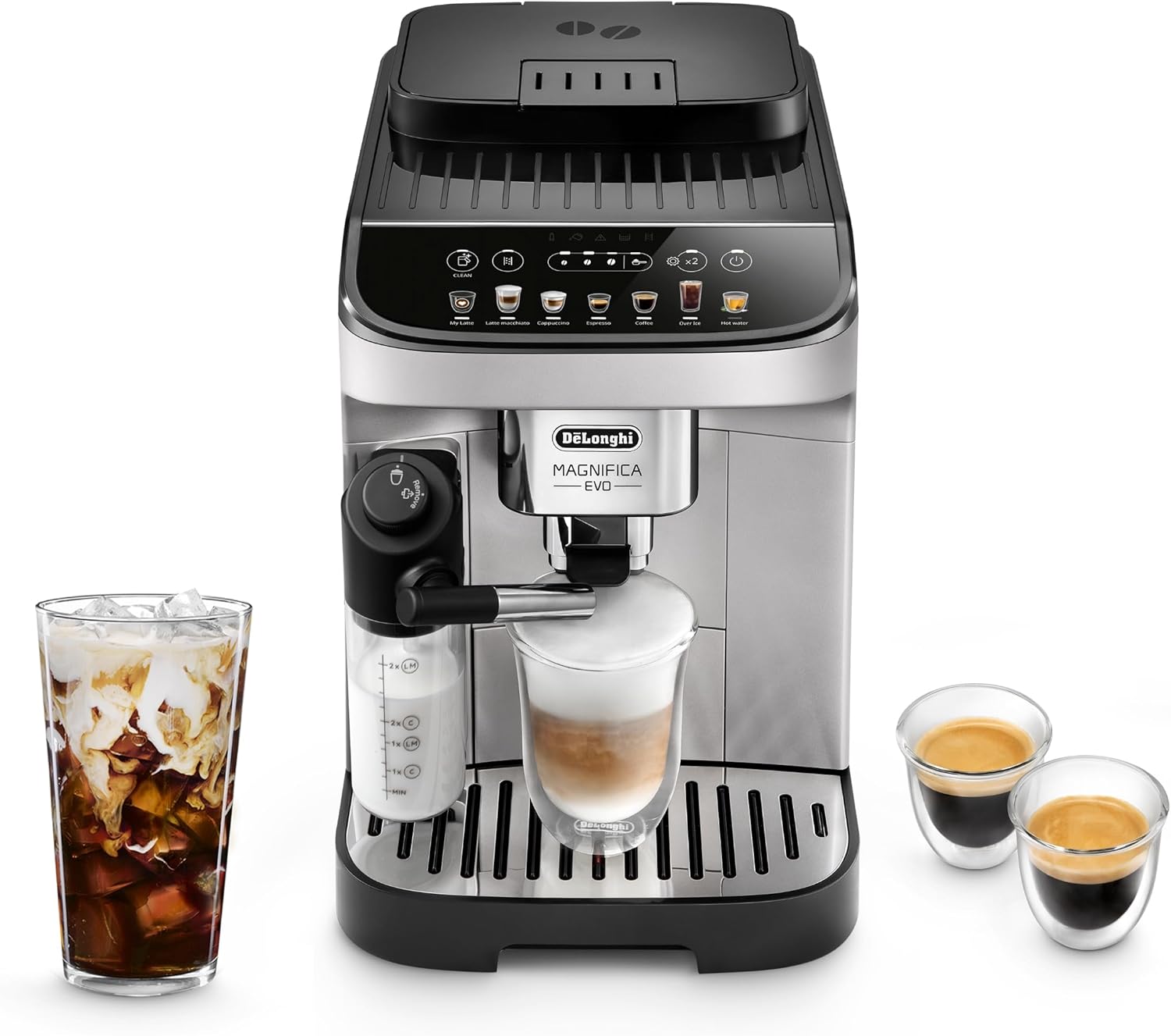
Our pickMagnifica Evo
The best-selling super-auto with LatteCrema milk
Typical price
$650
7.7
/10 overall
Scores side by side
| Dimension | De'Longhi Magnifica Start | De'Longhi Magnifica Evo |
|---|---|---|
| Espresso | ||
| Milk | ||
| Ease | ||
| Overall |
Key specs
| Spec | De'Longhi Magnifica Start | De'Longhi Magnifica Evo |
|---|---|---|
| Machine class | super | super |
| Built-in grinder | Yes | Yes |
| Milk system | auto-milk | auto-milk |
| Street price | $500 | $650 |
| Typical street price | $500 | $650 |
The Evo wins every category - by exactly one point
Begin with the uncomfortable part: the Start does not out-score the Evo anywhere. Espresso, milk, ease - the Evo leads on all three, and it leads by exactly one point on each. That uniformity is the most useful thing on the table. The Evo is not a specialist that spikes on one axis and coasts elsewhere; it is the same machine graded a notch higher across the board, which is why the overall lands at 7.7 against 6.7.
A point on a ten-point scale is a real edge, and it is worth being blunt that the Start's 6 for espresso and 6 for milk are middling numbers rather than hidden bargains. But read the shape of the gap before the size of it. Nothing in the recorded evidence separates these two by category: both are true super-automatics, both grind whole beans inside the machine, and both froth milk without anyone touching a pitcher.
The Start is a grade below the Evo, not a class below it. Anyone expecting the cheaper machine to be a semi-automatic in disguise, or to demand manual steaming, has the wrong picture. It does the same job with less headroom, and it does it for less money - which is the only argument it has, and the only one it needs to make.
Milk is where the money goes
If the extra $150 buys one thing, this is it. The Evo scored here is the ECAM29084SB, and its listing records a LatteCrema auto-milk carafe with auto-clean; the Start's listing records an automatic frother and five one-touch recipes. That single difference - a carafe that rinses its own milk circuit - is the most plausible source of both the milk point (7 against 6) and the ease point (9 against 8), and it is the only mechanical distinction the evidence actually pins down.
Whether that matters is a question about your mornings, not about the machines. Milk residue is the thing that turns a super-automatic into a chore: it has to be dealt with the same day, every day, and the more milk drinks a household pulls, the more that ritual decides whether the machine stays on the counter or gets quietly retired. A house making four cappuccinos before work feels an auto-clean carafe every single morning. A person making one flat white on Saturday will barely register it.
One limit worth stating plainly: the published specs support a one-point gap, not a verdict on foam texture. Nothing here measures microfoam quality, milk temperature, or how either system handles oat milk. Scores are computed from what the manufacturer publishes, so treat this as a documented difference in convenience, not an asserted difference in taste.
The espresso gap is the smallest reason to upgrade
Here is where the case for spending less gets real. On espresso the Evo scores 7 and the Start 6 - the same one-point spread as everywhere else - and both machines carry a built-in grinder that takes whole beans to cup without a separate appliance. The recorded evidence does not name a different brewing unit, a different grinder, or a different pressure figure between the two. The coffee-side gap is documented as one point, and nothing more.
For a household that drinks its coffee black, that reframes the decision entirely. The $150 premium buys a single point on the one axis being used, while the milk system it mostly pays for sits idle on the counter. That is a weak trade, and it is the clearest scenario in which the Start is the correct purchase rather than the compromise.
There is also a case for buying neither. Both automate the milk by design, which means the pitcher work is taken out of your hands. If the goal is to learn steaming, pour latte art, or dial a shot in by feel, an automatic frother is the wrong tool at any price - these machines are built to remove exactly the step you want to practice. A super-automatic buys consistency and speed. It does not buy control, and no amount of extra money here changes that.
Read the price ranges, not the headline prices
The $150 figure in the headline is a typical price, not a fixed one. The Start moves between $450 and $600; the Evo moves between $600 and $750. Those ranges touch. At the top of the Start's range and the bottom of the Evo's, both sit at $600 - and at that price there is no argument left for the Start, because the machine that scores a full point higher on every dimension costs exactly the same.
Run it the other way and the picture inverts. A $450 Start against a $750 Evo is a $300 spread for one overall point, which is a poor return on money unless the milk drinks are daily and plural. The real distance between these two is not $150. It is anywhere from $0 to $300 depending on the week, and that swing is larger than any specification separating them.
The practical consequence is that this comparison is time-sensitive in a way most are not. Check both current prices before committing to either. If the gap has narrowed toward $50, buy the Evo and stop thinking about it. If it has widened past $200 and the household mostly drinks espresso, the Start does the same job one grade down for meaningfully less money.
Choose the De'Longhi Magnifica Start if…
- Costs $150 less: $500 against $650
Choose the De'Longhi Magnifica Evo if…
- Higher overall score: 7.7/10 against 6.7/10
- Better espresso: 7/10 against 6/10
- Better milk: 7/10 against 6/10
- Better ease: 9/10 against 8/10
Verdict
Buy the Evo if milk drinks are a daily habit for more than one person: it scores 7.7 to the Start's 6.7, leads on espresso, milk and ease, and the auto-clean LatteCrema carafe is the part you thank yourself for every morning. Buy the Start if you drink your coffee black, or if the price gap has stretched past $200 - at $450 to $500 it is the cheapest credible bean-to-cup with automatic milk, and it loses by one point per category, not by a class. At $600 the Start makes no sense; the Evo starts there.
Still not sure?
Answer a few questions about your space and how you will use it, and the engine narrows the whole catalog down to the espresso machine that fits.
See also
Scores come from published manufacturer specs, normalized 1 to 10 across the whole catalog: espresso (type), milk (milkSystem), ease. The overall figure is the weighted mean of those dimensions, and the same weights apply to every model on the page.
Amazon links are affiliate links (tag: habilytics-20), at no extra cost to you. Scores and selection are computed from verified specs and never influenced by commissions.